Insights
eCommerce Website Development in India

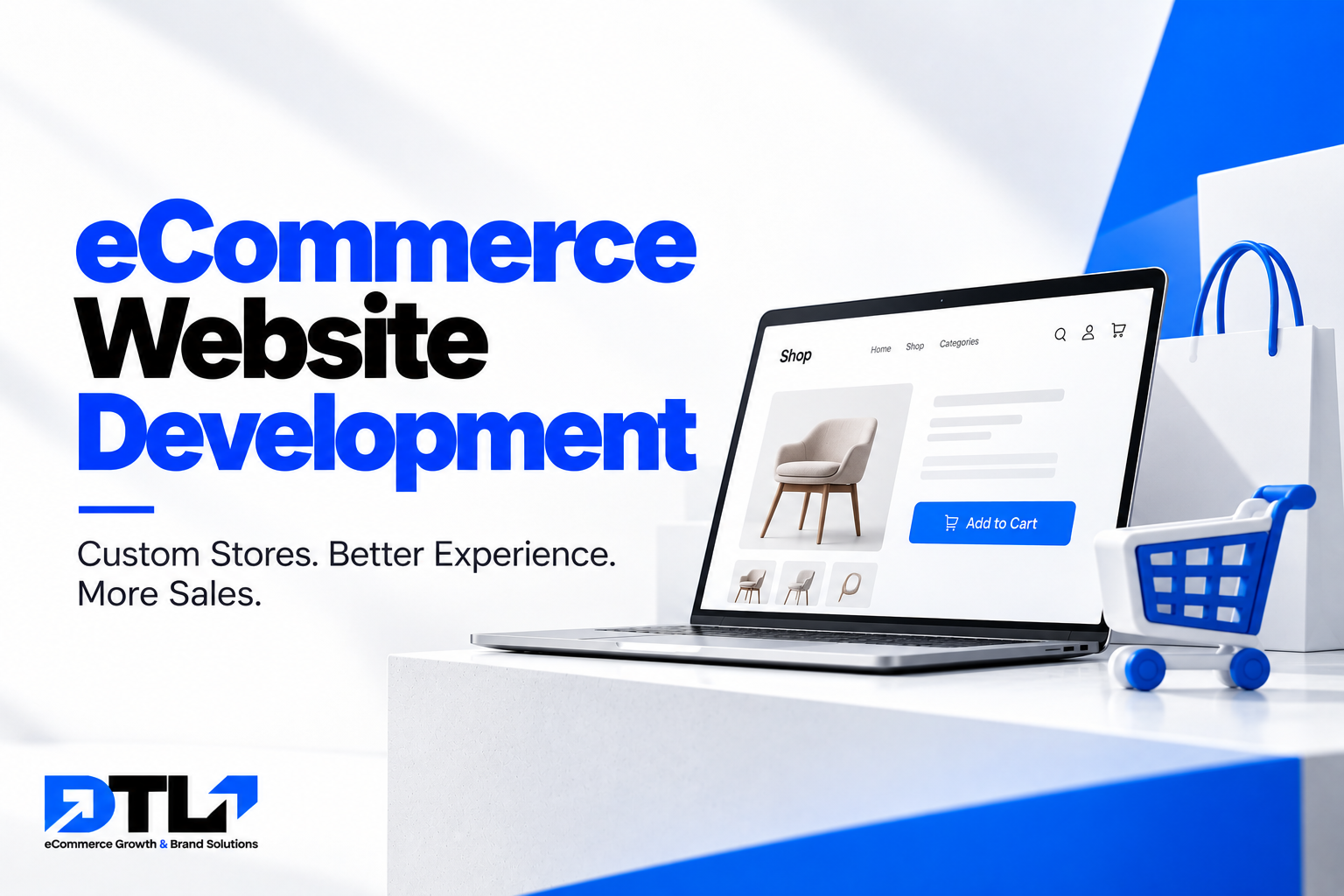
eCommerce Website Development in India : Build an Online Store That Grows With Your Business
This makes eCommerce Website Development much more than creating an attractive online store. A successful eCommerce website needs to combine design, functionality, product presentation, user experience, mobile responsiveness, performance, search visibility, and a smooth buying journey.
For businesses planning to sell products online, the website becomes an important part of the complete customer journey. It needs to make products easy to discover, information easy to understand, and purchasing easy to complete.
DTLIndia positions its eCommerce services around building high-performing Shopify and eCommerce stores that combine brand, user experience, SEO, and conversion strategy.
What Is eCommerce Website Development?
eCommerce Website Development is the process of planning, designing, developing, testing, and launching an online store where customers can discover products and complete purchases. Unlike a simple business website, an eCommerce website usually requires several connected components.
These can include:
- Product catalogues
- Product pages
- Category pages
- Search functionality
- Product filters
- Shopping cart
- Checkout
- Online payments
- Shipping information
- Customer accounts
- Order management
- Product reviews
- Contact and support options
The exact requirements depend on the business, products, target customers, sales model, and future growth plans. A small product-based business may need a relatively simple online store, while a larger D2C brand may require a much more advanced eCommerce system with hundreds or thousands of products, multiple categories, integrations, analytics, marketing tools, and customized customer journeys.
The objective should always be the same: create an online store that makes buying easier while giving the business a strong foundation for growth.
Why Does Your Business Need a Professional eCommerce Website?
Selling products online is not simply about uploading product images and adding a payment button.
Customers expect a complete shopping experience.
They want to know:
- What is the product?
- Is it suitable for their needs?
- How much does it cost?
- What are the product benefits?
- When will it arrive?
- Can it be returned?
- Is the website trustworthy?
- What do other customers say?
- How can they contact the business?
A professionally developed eCommerce website brings these elements together.
Build Your Own Digital Storefront
Marketplaces can provide access to large audiences, but businesses operating their own website have greater control over their digital storefront.
Your own eCommerce website allows you to control:
- Brand presentation
- Product storytelling
- Website structure
- Customer experience
- Product merchandising
- Content
- Offers
- Customer communication
- Analytics
- Conversion strategy
This gives your brand a platform that can evolve as the business grows.
Create a Stronger Brand Experience
Your online store should look like your brand. The colors, typography, photography, product presentation, content, navigation, and overall experience should work together. A generic template may allow a business to launch quickly, but a thoughtfully designed store can communicate the brand more clearly. For a D2C business, this is particularly important because customers may interact with the website before they ever interact with the physical product.
What Makes a Good eCommerce Website?
A good eCommerce website is not defined by appearance alone.
It should combine several important elements.
- Clear Website Structure
Customers should be able to understand the store quickly. Products should be organized into logical categories and collections.
For example, a fashion store may organize products by:
Men → Women → Kids → Accessories → New Arrivals
A home decor store may use:
Living Room → Bedroom → Kitchen → Decor → New Arrivals
The structure should reflect how customers naturally search for products.
- Easy Navigation
Navigation should help customers move through the store without confusion. A visitor should be able to move from the homepage to a category, then to a product page, and finally to checkout without unnecessary obstacles. Simple navigation is especially important when a store has a large number of products.
- Effective Product Pages
The product page is one of the most important parts of an eCommerce website. Customers need enough information to make a purchase decision.
A strong product page may include:
- Product name
- High-quality images
- Product description
- Key benefits
- Specifications
- Price
- Variants
- Size information
- Availability
- Delivery information
- Return information
- Reviews
- FAQs
- Clear purchase button
The objective is to answer the customer’s questions before they have to leave the page.
Product Images Matter
Online customers cannot physically touch or examine a product before purchasing it. Product photography therefore becomes extremely important.
Good product images can show:
- Product details
- Size
- Texture
- Color
- Different angles
- Product usage
- Scale
- Packaging
For some products, lifestyle photography can also help customers understand how the product may look or function in a real environment. The better customers understand a product visually, the easier it can be for them to evaluate it.
Mobile-Friendly eCommerce Development
A modern eCommerce store needs to work across smartphones, tablets, laptops, and desktop computers. Mobile shopping has made responsive design an essential part of online store development.
A mobile customer should be able to:
- Browse categories
- Search products
- View images
- Select variants
- Add products to the cart
- Enter delivery information
- Make payment
- Track or understand their order
without fighting with the website interface. Buttons should be easy to tap, text should remain readable, images should display properly, and navigation should remain simple. A store that works well on desktop but creates friction on mobile can lose potential customers.
Website Speed and Performance
Performance is another important part of eCommerce Website Development. Customers generally do not want to wait for every product page to load. Slow pages can interrupt browsing and make the purchasing process frustrating.
Performance can be influenced by:
- Image sizes
- Hosting
- Website code
- Third-party scripts
- Plugins and apps
- Heavy animations
- Tracking tools
- Poorly optimized resources
A professional eCommerce development process should therefore consider performance from the beginning. Images should be optimized, unnecessary resources should be minimized, and the website should be tested across relevant devices.
SEO-Friendly eCommerce Website Development
A store cannot generate organic traffic if search engines cannot properly understand its pages. This is why SEO should be considered during eCommerce Website Development rather than added as an afterthought.
An SEO-friendly eCommerce store can include:
- Logical category structure
- Search-friendly URLs
- Optimized page titles
- Meta descriptions
- Proper heading structure
- Product content
- Category content
- Image ALT text
- Internal links
- Mobile responsiveness
- Good website performance
The website structure should help both customers and search engines understand the relationship between products, categories, and important pages.
Why Category Pages Matter?
Many businesses focus heavily on individual product pages and overlook category pages. Category pages can be valuable because they help customers browse groups of related products.
A useful category page can contain:
- Category title
- Relevant introduction
- Product listings
- Filters
- Sorting options
- Internal links
- Useful supporting content
For larger stores, category pages can also create additional opportunities to target relevant search queries.
Search Functionality and Product Filters
As the number of products increases, website search becomes increasingly important. Imagine a store with hundreds of products. A customer looking for one particular item should not have to browse every category manually. Search functionality can help users quickly locate relevant products. Filters can also make product discovery easier.
Depending on the store, filters may include:
- Price
- Size
- Color
- Material
- Brand
- Availability
- Product type
- Rating
The right filters depend on what customers actually use when making purchasing decisions.
Shopping Cart and Checkout Experience
Getting a customer to the cart is not the final step. The checkout experience can determine whether the purchase is completed. A complicated checkout can create unnecessary friction.
Customers may abandon a purchase if they encounter:
- Too many unnecessary fields
- Confusing navigation
- Unexpected costs
- Limited payment options
- Unclear delivery information
- Technical errors
- Poor mobile usability
A good checkout should be straightforward and transparent. Customers should understand what they are buying, what they are paying, how the order will be delivered, and what happens after payment.
Payment Gateway Integration
An eCommerce website needs a reliable way to accept payments. Depending on the business and target market, an online store may support different payment options.
These can include:
- UPI
- Credit cards
- Debit cards
- Net banking
- Digital wallets
- Other supported payment methods
- Cash on delivery, where applicable
The payment experience should be integrated into the overall customer journey. A professional eCommerce Website Development process should consider the business’s payment requirements, customer preferences, security considerations, and operational workflow.
Shipping and Delivery Information
Customers want to know when and how their order will arrive. An eCommerce website should communicate important delivery information clearly.
This may include:
- Delivery areas
- Estimated delivery time
- Shipping charges
- Free shipping conditions
- Order tracking
- Return process
- Exchange policy
Clear information can reduce uncertainty and help customers make purchasing decisions with greater confidence.
Trust Is a Major Part of eCommerce
Customers need to trust an online store before sharing payment information or placing an order.
Your website can communicate trust through:
- Clear business information
- Contact details
- Customer reviews
- Product reviews
- Secure payment options
- Transparent policies
- Return information
- Shipping details
- Professional product photography
- Consistent branding
Trust should not be treated as a single section on the website. It should be built throughout the complete customer experience.
eCommerce Website Development for D2C Brands
Direct-to-consumer businesses depend heavily on their websites. A D2C website often needs to do more than sell a product. It needs to communicate the brand story, explain product benefits, build trust, capture customer interest, and encourage repeat purchases.
A D2C website can therefore include:
- Brand storytelling
- Product education
- Customer reviews
- Product comparisons
- Educational content
- Bundles
- Offers
- Frequently asked questions
- Subscription options
- Repeat-purchase opportunities
DTLIndia currently describes its eCommerce work as supporting D2C businesses by combining brand, UX, SEO, and conversion strategy.
Choosing the Right eCommerce Platform
The platform you choose can influence how your store is managed and developed. Different businesses may have different requirements.
Factors to consider include:
- Number of products
- Budget
- Technical requirements
- Design flexibility
- Payment options
- Integrations
- Inventory management
- Marketing requirements
- Scalability
- Maintenance
For some businesses, Shopify may be appropriate. For others, another eCommerce platform may better match their technical or operational requirements. The important thing is to select a platform based on the actual business requirement rather than simply choosing the platform that is currently popular.
Shopify and eCommerce Development
Shopify is one of the platforms businesses can use to build and manage online stores. A Shopify store can be customized around a brand’s products, customers, and business requirements. However, successful Shopify development is more than selecting a theme.
The store may require:
- Theme customization
- Homepage design
- Collection structure
- Product page optimization
- Navigation
- Payment configuration
- App integration
- Mobile optimization
- SEO structure
- Conversion-focused design
DTLIndia currently lists both Shopify Store Development and eCommerce Store Development as part of its web/eCommerce offering.
eCommerce Website Development and Conversion
Traffic alone does not guarantee sales. A store may receive visitors but still struggle to generate purchases.
This can happen when visitors encounter problems such as:
- Unclear product information
- Weak product presentation
- Poor navigation
- Lack of trust
- Complicated checkout
- Weak calls-to-action
- Poor mobile experience
This is where conversion-focused eCommerce development becomes important. Every major page should have a purpose. The homepage should introduce the brand. Category pages should help customers browse. Product pages should help customers evaluate. The cart should summarize the purchase. Checkout should make completion easy. The complete website should guide customers logically from discovery to purchase.
Analytics and Continuous Improvement
Launching the website should not be considered the end of the project. Once the store is live, businesses can use data to understand how customers interact with it.
Useful metrics may include:
- Website traffic
- Product views
- Add-to-cart rate
- Checkout activity
- Conversion rate
- Average order value
- Returning customers
- Traffic sources
- Top-performing products
These insights can help identify areas that need improvement. For example, if a product receives significant traffic but very few customers add it to the cart, the product page may need to be reviewed. If customers add products to the cart but frequently leave during checkout, the checkout journey may need attention. A data-driven approach helps businesses make improvements based on actual customer behavior.
Common eCommerce Website Mistakes
Building Only for Appearance
A beautiful website is useful, but appearance alone does not create a successful online store.
Poor Product Information
Customers need enough information to understand what they are purchasing.
Complicated Navigation
If customers cannot find products easily, they may leave.
Ignoring Mobile Users
A large number of customers may access the store through smartphones.
Slow Website
Performance issues can negatively affect the shopping experience.
Hidden Costs
Unexpected shipping charges or other costs appearing late in checkout can create friction.
Weak Trust Signals
Customers need reasons to feel comfortable purchasing from the business.
No Clear Customer Journey
Every stage from landing page to checkout should connect logically.
How to Choose an eCommerce Website Development Company
Selecting an eCommerce development partner is an important business decision. Before choosing an agency, review its approach rather than looking only at the price.
Check Previous eCommerce Work
Look at previous stores and evaluate:
- Design
- Navigation
- Mobile experience
- Product presentation
- Website structure
- User experience
Understand What Is Included
Ask whether the project includes:
- Design
- Development
- Mobile optimization
- Product setup
- Payment integration
- Testing
- SEO foundations
- Launch support
- Maintenance
Think About Future Growth
Your business may start with 20 products and eventually grow to hundreds. Your website should be planned with that possibility in mind.
Understand the Business Strategy
An eCommerce website should be connected to business goals. The right development partner should understand what you are selling, who your customers are, and what you want the website to achieve.
Why Choose DTLIndia for eCommerce Website Development?
DTLIndia currently presents its eCommerce offering around high-performance Shopify and eCommerce stores that combine brand, UX, SEO, and conversion strategy. Its website also identifies eCommerce Store Development, Product Page Design, CRO Optimization, Digital Marketing, Sales Funnel Design, SEO, and AI Optimization as connected parts of its digital offering.
DTL’s broader approach emphasizes being business-first, providing end-to-end expertise, maintaining practical and transparent processes, and building digital assets with future growth in mind. This approach is relevant because an eCommerce website should not be treated as an isolated design project. It is a business asset. It can become the foundation for product sales, customer acquisition, brand building, content, marketing campaigns, and long-term digital growth.
Build an eCommerce Website That Is Ready to Grow
A successful online store needs more than products and a checkout button. It needs a clear structure, strong product presentation, responsive design, reliable functionality, useful content, smooth navigation, secure payment options, and a customer journey that makes sense.
Good eCommerce Website Development brings these elements together.
Whether you are launching your first online store, moving an existing business online, redesigning an outdated store, building a D2C brand, or expanding an existing eCommerce operation, the website should be developed around the way your customers shop and the way your business plans to grow. The right approach starts with understanding the business, products, audience, and objectives. From there, the website can be planned, designed, developed, tested, launched, and continuously improved. An eCommerce website should not simply be built to go live.
It should be built to sell, serve customers, represent the brand, and support the next stage of business growth.
For more Details Contact us at: info@dtljodhpur.com